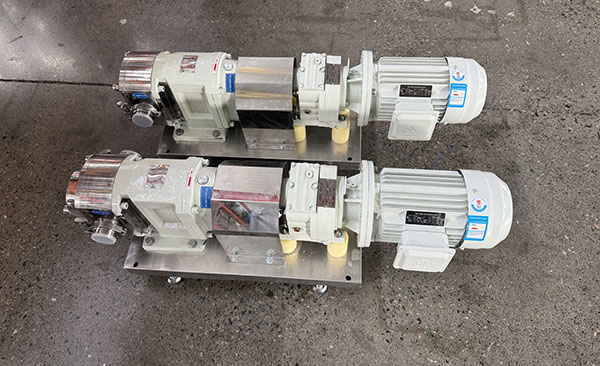
Improving High-Viscosity Fluid Transfer with a 3RP Rotary Lobe Pump
2026-09-17 15:41:37
Read:
Share:
In industrial production, as the viscosity of high-viscosity media increases, so does their flow resistance, which is why traditional pumps may experience problems such as difficulty in suction, clogging, reduced flow rate, and unstable delivery during the pumping process. Regarding media such as oils, syrups, honey, pastes, and high-viscosity chemicals, the pumping process requires not only sufficient delivery capacity but also minimization of impact and shear forces on the media. The 3RP rotary pump continuously creates a pumping chamber through the rotation of its rotor, allowing high-viscosity media to flow continuously from the inlet into the pump chamber and be pushed to the outlet, hence demonstrating strong adaptability in high-viscosity fluid transfer applications.
The key to this device's enhanced efficiency in conveying high-viscosity media lies in the fact that it does not rely solely on high-speed rotation to achieve flow, but rather uses the working chamber formed during the rotor's rotation to transport the medium from the inlet side to the outlet side. For media with high viscosity and poor flowability, this conveying method effectively mitigates the adverse effects associated with relying solely on high-speed operation. Further, this series allows users to select the appropriate rotational speed based on the physical properties of the conveyed medium, thereby better meeting conveying requirements under various operating conditions.
However, for highly viscous fluids, the rotational speed is not directly proportional to pumping efficiency. When the rotational speed is too high, it may impose excessive loads on the equipment, subject the fluid to unnecessary shear forces, or generate excessive heat. Therefore, during the pumping of highly viscous fluids such as honey or syrup, it is advisable to start at a suitable low or medium speed and gradually adjust the parameters based on discharge pressure, actual flow rate, motor load, and fluid condition to ensure that the pump’s capacity remains aligned with system requirements. This approach not only maintains a stable flow rate but also prevents the equipment from operating under unreasonably high loads for extended periods.
Due to the 3RP high viscosity rotor pump’s excellent self-priming capabilities, it helps improve the flow conditions of high-viscosity media as they enter the pump chamber, making it ideal for systems that continuously extract material from hoppers or low-level containers. This reduces flow rate fluctuations resulting from insufficient suction during conveyance, ensuring a more stable material supply throughout the production line. Nevertheless, if the feed piping is too long or contains too many bends, resistance on the suction side will increase, preventing the pump from adequately drawing in the material. In practical operating conditions, therefore, the pipe diameter should be determined appropriately based on the viscosity of the medium, and the suction piping length should be minimized as much as possible during design, while simultaneously limiting unnecessary bends.
This equipment also operates on a positive displacement principle and features low shear and low pulsation, enabling it to preserve the original structure and activity of the medium when conveying suspensions containing soft solid particles. Its large-diameter design and spacious, dead-end-free flow path ensure that no blockages or residue occur when conveying media containing solid particles and fibers, rendering it particularly effective for media where excessive shear must be avoided.
During the conveyance of chocolate, jam, cheese, honey, and other low-flow media, the 3RP series stainless steel pumps excel at meeting the requirements for stable feeding and continuous conveyance across various industrial production lines by leveraging their positive-displacement design, adjustable speed, outstanding self-priming capability, and low-shear characteristics, leading to significantly improved conveyance efficiency in applications involving high-viscosity media.